4. GENERAL METHODS OF CALCULATION OF HEAT EXCHANGERS
4.1. Method of factor F
This method uses a correction value F:
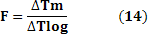
Proposing the general equation of heat step:

Insulating Δtm the first equation:

It proposed the 2 thermal balance equations:


Where:
q = heat a fluid that is transmitted to another (J / s)
W1 = mass flow of hot fluid (1) (kg / s)
W2 = mass flow of cold fluid (2) (kg / s)
Cp1 = heat capacity of the hot fluid (1) (J / kg · K)
Cp2 = cold fluid heat capacity (2) (J / kg · K)
T1i = initial temperature of the hot fluid (1) (K)
T10 = final temperature of hot fluid (1) (K)
T2i = initial temperature of cold fluid (2) (K)
T20 = cold end temperature of the fluid (2) (K)
U = convection coefficient (KJ / h · m 2 K)
A = area of the passage of heat (m 2)
∆Tm = logarithmic mean temperature difference
With equations 1, 2 and 16 can find the variables necessary to find the value of F graphically.
This correction value F is a function of R, P and configuration (2:1, 1:1, 2:4, etc.)
Where:
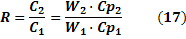

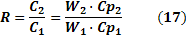
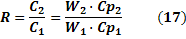
With equations 17 and 18, and the configuration of heat exchanger can go to the chart and find
the value of F.
We can find two types of problems:
- DESIGN PROBLEM.
INFORMATION:
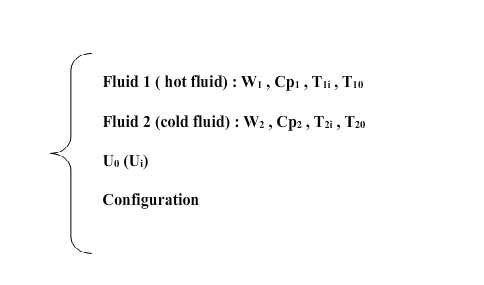
With this information you must be find the area (A0 or Ai).
The steps to follow in order to find this area are:
1) Proposed the two heat balance equations to find q:


2) Proposed the general equation of heat step:

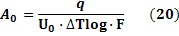
Insolate area (A0):
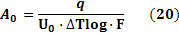

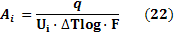
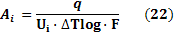
Insolate area (Ai):
3) Make diagram of temperature distribution and calculate Δtlog.
4) Calculate R and P:


5) Go to the graph and found the two values of R and Q, find F, as shown
below
( calculated value of P = 0.6 and R = 1.0):
6) Finally, using the general equation of heat step through the area is calculated
(A0 o Ai):
- HEAT PROBLEM.
INFORMATION:
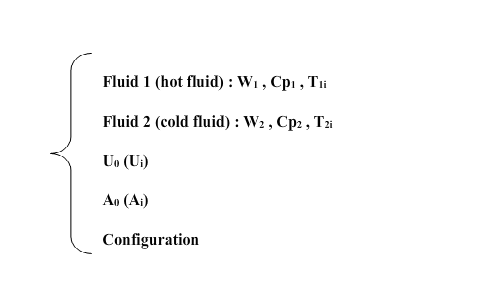
With this information and using different equations have to find the final temperature
(T10 and T20).
These problems can be solved by groping along the following steps:
-Rough estimate temperature (assume T'10 T'20).
1) Proposed the general equation of heat step:


2) Make the diagram of distribution temperatures and calculate ∆Tlog.
3) Calculate R and P:

4) Go to the graph and found the two values of R and P, find F, as shown below
( calculated value of P = 0.6 and R = 1.0):
5) In general equation of heat step, is the value of heat flux (q):


6) Proposed the two equations of thermal balance to find the temperatures:


7) Check the values found are equal to those alleged. Otherwise, they must
assume new initial values and repeat the process explained.
- Rough estimate heat flow (we assume q').
1) Proposed the two equations of thermal balance to find the temperatures:
2) Proposed the general equation of heat step:
3) Make the diagram of distribution temperatures and calculate ∆Tlog.
4) Calculate R and P:

5) Go to the graph and with values of R and P, found F.
6) In general equation of heat step, is the value of heat flux (q):


7) Check the values found are equal to those alleged. Otherwise, they must
assume new initial values and repeat the process explained.


